
How Much Do Americans Know About Politics? Political Knowledge and Americans’ Views of Democracy
Hwayong Shin | Weidenbaum Center Postdoctoral Fellow in Survey Research
November 13, 2026
As we reflect on another election held in the United States this month, some may wonder: How much do Americans actually know about politics? An informed citizenry has long been considered essential for elections to fulfill democratic accountability, through which voters reward well-performing politicians and parties, and punish those who perform poorly (Delli Carpini & Keeter 1996; Pande 2011). Political knowledge plays a central role in this process, enabling citizens to evaluate their leaders and make informed vote choices.
Yet being knowledgeable about politics is a difficult task, even during election seasons. As Election Day approaches, Americans encounter a flood of information about candidates, government, and politics at both the national and local levels. Elections thus offer opportunities for citizens to learn about politics, as candidates compete for their attention and support (Hirano et al. 2014; Nadeau et al. 2008; Stoetzer et al. 2024). However, even with ample information at their disposal, exposure to political information does not necessarily translate into political knowledge. Not only do the demands of everyday life limit the time and attention Americans can devote to political learning (Lippmann 1992), but many feel overwhelmed or stressed by political news and actively avoid it (Hasell & Halversen 2024; Toff & Kalogeropoulos 2020), express cynicism toward politics (Lee & Jones-Jang 2022), and shy away from political conversations (Krupnikov & Ryan 2022). These challenges may vary across individuals and their social environments, potentially contributing to differences in political knowledge across age groups and partisan affiliations (Anson 2018; Jennings 1996; Trepte & Schmitt 2017). This raises the question of which groups are more informed about politics.
Beyond individual characteristics, the environment in which people live may also shape how much they know about politics. Previous research has examined whether residents in swing states, where elections are highly competitive, are more interested and engaged in politics (Gimpel et al. 2007; Wolak 2007), in part because campaign activity is often more intense in these states (Panagopoulos 2009). As of 2026, do Americans living in swing states know more about politics than those living elsewhere?
Political knowledge has also long been central to debates about democratic citizenship. While some research highlights the democratic value of learning more about how democracy works (Cho 2014; Michalski et al. 2026), others claim that extensive political knowledge is unnecessary, as citizens can make choices as if they were well-informed if they relied on the right cues, such as partisanship (Lupia & McCubbins 1998), yet other work has shown that these heuristics may sometimes go wrong (Dancy & Shaegley 2012; Lau & Redlawsk 2001). Prior research further suggests that greater factual knowledge does not necessarily translate into changes in political attitudes (Nyhan et al. 2020), and even highlights the potential downsides of knowledge, finding that more knowledgeable individuals may exhibit stronger biases in their political beliefs (Kahan et al. 2017). Thus, whether knowing more about contemporary American politics is related to greater commitment to democratic norms remains an open question.
Leveraging Wave 9 of the Weidenbaum Center Survey (WCS), conducted in June 2026, this report examines how political knowledge varies by age, partisan identity, and electoral competitiveness of the respondents’ states, and whether political knowledge is associated with Americans' views of democracy—as reflected in their confidence in election outcomes and attitudes toward actions that undermine democratic principles. It is worth noting that political knowledge is itself a contested concept, with a long-held and deep scholarly debate on what citizens should know to be democratically competent, and how best to measure political knowledge (e.g., Barabas et al. 2014; Cramer & Toff 2017; Lupia 2016; Kraft 2024; Mondak 2017). Wave 9 of WCS includes conventional factual questions about political institutions and officeholders (e.g., ANES 2024; Borelli & Gracia 2023). Although the questions have limitations and do not capture everything citizens may or should know about politics, they follow a widely used approach to measuring political knowledge. Using this measure, this report examines differences in political knowledge across groups and its relationship with democratic attitudes.
How Much Do Americans Know about U.S. Politics?
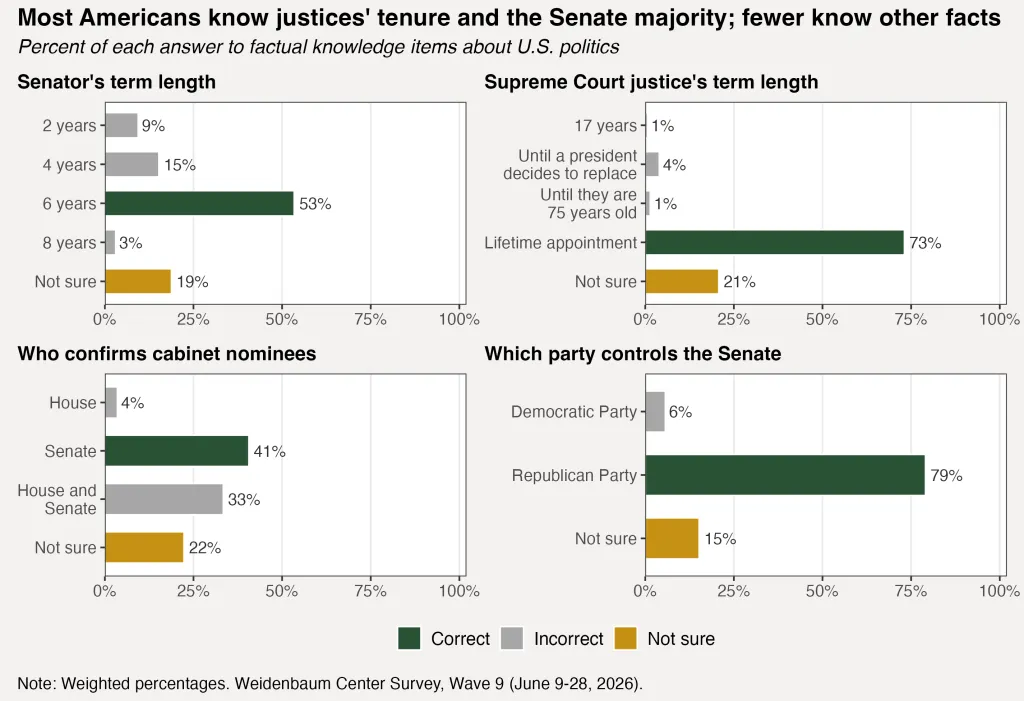
To examine how much Americans know about U.S. politics, respondents were asked four factual questions: (1) how many years a U.S. senator serves in one full term, (2) how long a U.S. Supreme Court justice is appointed for, (3) which chamber of Congress confirms presidential nominees for cabinet positions, and (4) which political party held the majority in the U.S. Senate at the time of the survey. Respondents could also select “Not sure” for each question.
For reference, the correct answers at the time of WCS Wave 9 in June 2026 were: six years, lifetime appointment, the Senate, and the Republican Party, respectively. As shown in the figure below, 53% of respondents knew that a U.S. senator's term is six years, while only 41% knew that the Senate is responsible for confirming Cabinet nominees. A greater proportion of respondents (73%) knew that Supreme Court justices serve lifetime appointments. An even larger share (79%) correctly identified the Republican Party as the party controlling the Senate as of June 2026.
Does political knowledge vary by age and partisan identity? The graph below shows the average percentage of correct answers across the four factual questions. Consistent with a recent report showing that older Americans tend to be more knowledgeable about U.S. politics (Shearer et al. 2026), respondents under 30 and those aged 30–44 answered approximately 53–55% of the questions correctly on average, compared with 65% among those aged 45–64 and 73% among those aged 65 and older. Based on the 95% confidence intervals, political knowledge is significantly higher among the two older age groups compared with the two younger age groups. Political knowledge is also significantly higher among those aged 65 and older than among those aged 45–64.
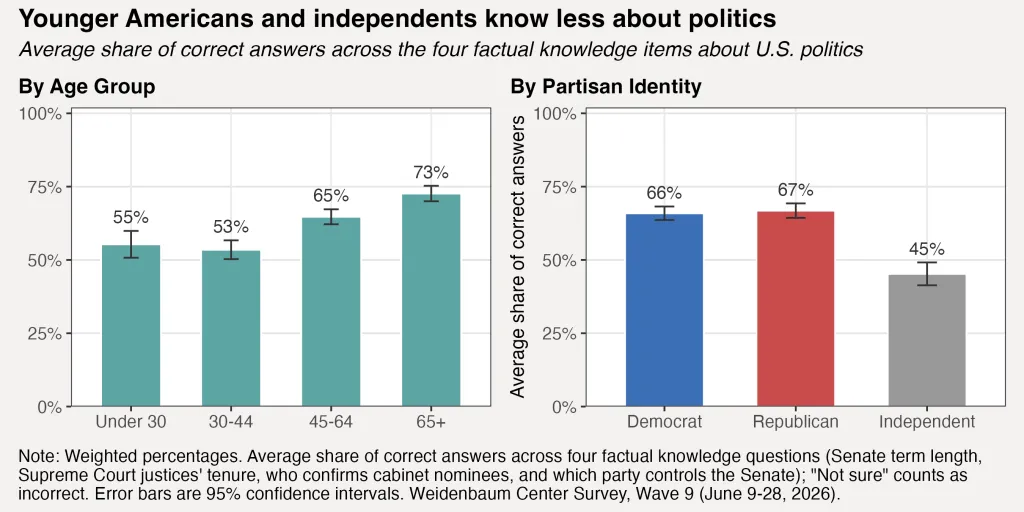
Findings on partisan identity suggest that identifying with a political party—including those who initially say they don’t support one but lean toward one party in a follow-up question—is associated with greater political knowledge. On average, Democrats answered 66% of the questions correctly, whereas Republicans answered 67% correctly. The two partisan groups exhibited similar levels of political knowledge. However, independents who did not identify with or lean toward either party answered only 45% of the questions correctly, significantly lower than both partisan groups. This finding is consistent with prior research suggesting that independents tend to be less politically informed than partisans, potentially because they have less motivation to seek or acquire political knowledge (Dyck & Pearson-Merkowitz 2023).
Do Americans in Politically Contested Regions Know More about Politics?
Beyond individual traits such as age and partisanship, does the environment in which people live matter for how much they know about politics? To explore this question, the figure below examines differences in political knowledge across three types of states. Below, the U.S. map classifies states as blue, red, or swing states based on the 2024 presidential election results. Swing states (shown in purple) refer to the seven battleground states in the 2024 election: Arizona, Georgia, Michigan, Nevada, North Carolina, Pennsylvania, and Wisconsin (Davis 2024; FitzGerald 2024; Shepard 2024). Among the remaining states, red states are those won by Donald Trump, whereas blue states are those won by Kamala Harris.
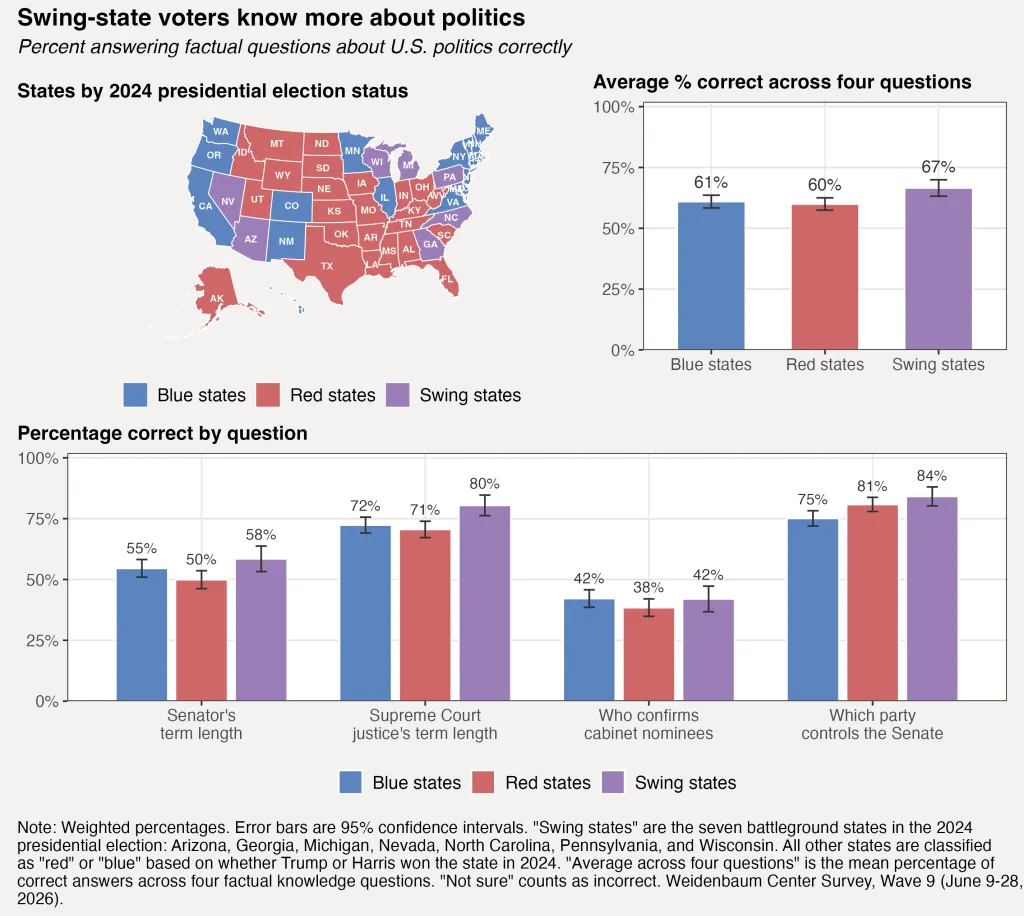
As shown in the figure next to the U.S. map, residents of swing states answered approximately 67% of the factual questions correctly, compared with 61% and 60% among residents of blue and red states, respectively. Average political knowledge was similar across blue and red states. However, swing-state residents demonstrated significantly higher levels of political knowledge than residents of either blue or red states.
Swing-state residents performed better on individual factual questions as well, as shown in the figure below the map. The percentage of respondents who answered each question correctly was higher in swing states: 58% for the length of a U.S. senator's term, 80% for Supreme Court justices' tenure, 42% for Cabinet nominee confirmation, and 84% for the party controlling the Senate. Respondents in blue and red states generally had lower percentages of correct answers, with one exception: blue-state residents also scored 42% on the Cabinet confirmation question.
Another interesting pattern is that blue-state residents tended to perform better than red-state residents on three of the four questions. The exception was the Senate majority question, where 81% of red-state residents answered correctly, compared with 75% of blue-state residents. This pattern is interesting in light of the fact that Republicans held the majority of seats in the Senate at the time of the survey.
Is Political Knowledge Related to Americans’ Views on Democracy?
Is knowing more about politics associated with Americans’ views on democracy? As discussed earlier, political scientists have long debated the role of political knowledge in democracy and what types of knowledge matter most. Previous studies have examined whether greater knowledge of democratic institutions and principles is associated with support for democracy (e.g., Cho 2014; Michalski et al. 2026). However, these studies have used different measures of political knowledge than those employed in the WCS.
To explore this relationship, respondents were asked to indicate their views on two aspects of U.S. democracy: first, their confidence that votes will be counted as intended in the November 2026 election, and second, their support for actions that prioritize partisan interests over democratic norms. The latter includes actions such as reducing polling stations in areas favorable to the opposing party, ignoring unfavorable court rulings, prosecuting journalists, and rejecting election results. Further details about these measures are provided in the Methods section.
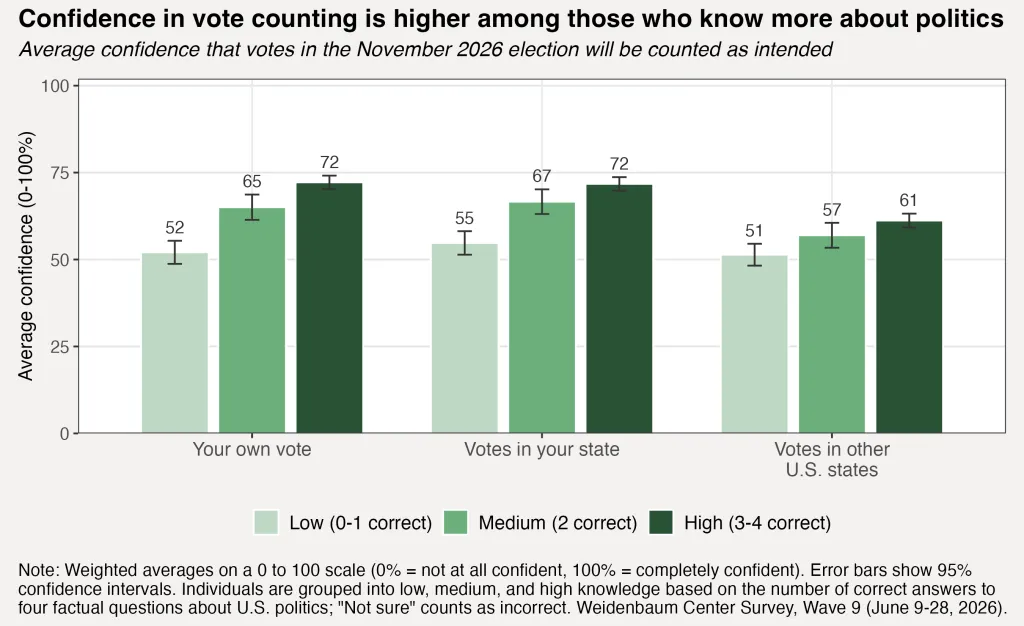
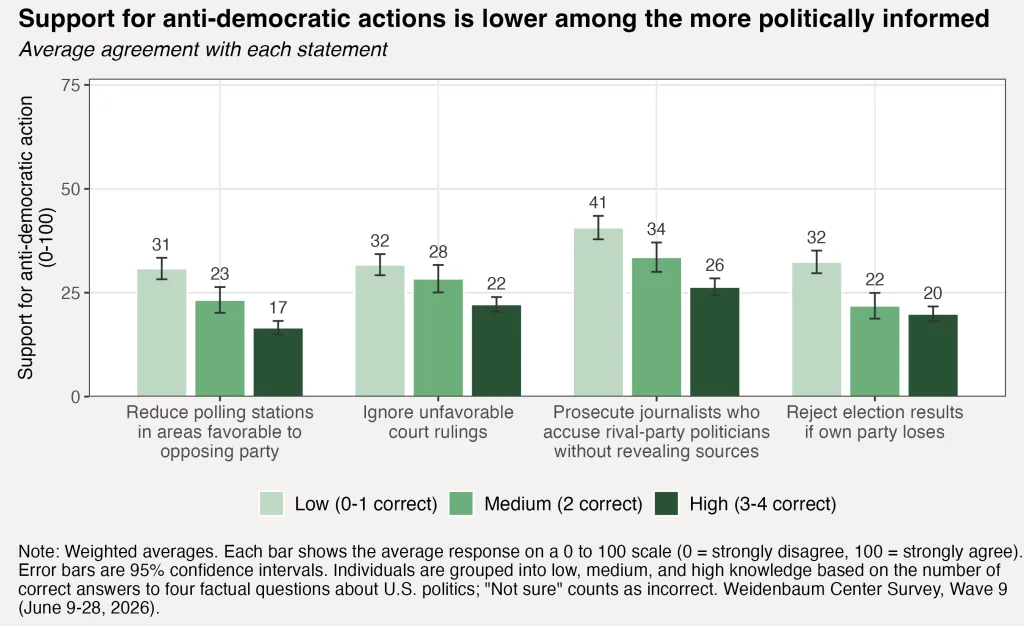
To examine how views on democratic processes and norms differ by political knowledge, respondents are divided into three groups based on their answers to the four factual questions about U.S. politics: Low (0–1 correct answers), Medium (2 correct answers), and High (3–4 correct answers).
First, are individuals who know more about U.S. politics more confident that votes will be counted accurately in the November 2026 election? Across all three measures of confidence—their own votes, votes in their state, and votes in other U.S. states will be counted as intended—individuals with higher levels of political knowledge tended to be more confident about election outcomes. Respondents with high political knowledge expressed the greatest confidence in their own votes (72%), votes in their state (72%), and votes in other states (61%). Confidence was lower among those with medium political knowledge (65%, 67%, and 57%, respectively) and lowest among those with low political knowledge (52%, 55%, and 51%). Individuals with low political knowledge were much less confident than those with medium or high political knowledge, with statistically significant differences between the low-knowledge group and each of the other two groups.
Second, are individuals who know more about U.S. politics more or less supportive of actions that prioritize partisan interests over democratic norms? As shown in the figure below, individuals with higher levels of political knowledge expressed less support for all four anti-democratic actions. On a scale from 0 to 100, respondents with low political knowledge expressed the greatest support for reducing polling stations in areas favorable to the opposing party (31), ignoring unfavorable court rulings (32), prosecuting journalists who accuse politicians without revealing their sources (41), and rejecting election results if their own party loses (32). In contrast, individuals with high political knowledge expressed substantially lower support for these actions (17, 22, 26, and 20, respectively), while respondents with medium political knowledge fell in between (23, 28, 34, and 22, respectively). Most differences between the three knowledge groups were statistically significant.
In Closing
The findings from Wave 9 of WCS reveal that political knowledge among Americans varies across different types of facts, individual characteristics such as age and partisanship, and where people live. Younger Americans, those without partisan affiliations, and those living in less electorally competitive states tend to be less informed about U.S. politics. These differences may have important implications for democracy, as individuals with greater political knowledge tend to be more confident in election outcomes and less supportive of actions that prioritize partisan interests over democratic norms.
The patterns across demographic groups and regions suggest that accumulated life experience, political engagement, and the salience of politics in people's everyday environments may matter for how much they know about politics. The relationship between political knowledge and attitudes toward democratic processes also speaks to longstanding scholarly discussions about the importance of political knowledge for democracy (e.g., Barabas et al. 2014; Cramer & Toff 2017).
In light of these findings, it is worth revisiting a claim made by political scientists Delli Carpini and Keeter (1996) three decades ago—and considering whether their claim still resonates in the present day: “Political information is to democratic politics [...] what money is to economics; it is the currency of citizenship” (p. 8).
Author
Hwayong Shin is a postdoctoral fellow at the Weidenbaum Center on the Economy, Government, and Public Policy at Washington University in St. Louis.
Acknowledgement: I am grateful to Taylor Carlson and Lukas Alexander for helpful comments.
Bibliography
American National Election Studies. (2025). ANES 2024 Time Series Study Full Release [dataset and documentation](Version August 8, 2025). https://electionstudies.org/data-center/2024-time-series-study/
Anson, I. G. (2018). Partisanship, Political Knowledge, and the Dunning-Kruger Effect. Political Psychology, 39(5), 1173–1192. https://doi.org/10.1111/pops.12490
Barabas, J., Jerit, J., Pollock, W., & Rainey, C. (2014). The Question(s) of Political Knowledge. American Political Science Review, 108(4), 840–855. https://doi.org/10.1017/S0003055414000392
Borelli, G., & Gracia, S. (2023, November 7). What Americans know about their government. Pew Research Center. https://www.pewresearch.org/short-reads/2023/11/07/what-americans-know-about-their-government/
Cho, Y. (2014). To Know Democracy Is to Love It: A Cross-National Analysis of Democratic Understanding and Political Support for Democracy. Political Research Quarterly, 67(3), 478–488. https://doi.org/10.1177/1065912914532721
Cramer, K. J., & Toff, B. (2017). The Fact of Experience: Rethinking Political Knowledge and Civic Competence. Perspectives on Politics, 15(3), 754–770. https://doi.org/10.1017/S1537592717000949
Dancey, L., & Sheagley, G. (2013). Heuristics Behaving Badly: Party Cues and Voter Knowledge. American Journal of Political Science, 57(2), 312–325. https://doi.org/10.1111/j.1540-5907.2012.00621.x
Davis Jr., E. (2024, November 5). 7 States That Could Sway the 2024 Presidential Election. US News & World Report. https://www.usnews.com/news/elections/articles/7-swing-states-that-could-decide-the-2024-presidential-election
Delli Carpini, M. X., & Keeter, S. (1996). What Americans Know about Politics and why it Matters. Yale University Press. https://yalebooks.yale.edu/book/9780300072754/what-americans-know-about-politics-and-why-it-matters/
Dyck, J. J., & Pearson-Merkowitz, S. (2023). The Power of Partisanship. Oxford University Press. https://doi.org/10.1093/oso/9780197623787.001.0001
FitzGerald, J. (2024, June 13). Seven swing states set to decide the 2024 US election. BBC. https://www.bbc.com/news/articles/c511pyn3xw3o
Gimpel, J. G., Kaufmann, K. M., & Pearson-Merkowitz, S. (2007). Battleground States versus Blackout States: The Behavioral Implications of Modern Presidential Campaigns. The Journal of Politics, 69(3), 786–797. https://doi.org/10.1111/j.1468-2508.2007.00575.x
Hasell, A., & Halversen, A. (2024). Feeling Misinformed? The Role of Perceived Difficulty in Evaluating Information Online in News Avoidance and News Fatigue. Journalism Studies, 25(12), 1441–1459. https://doi.org/10.1080/1461670X.2024.2345676
Hirano, S., Lenz, G. S., Pinkovskiy, M., & Snyder Jr., J. M. (2015). Voter Learning in State Primary Elections. American Journal of Political Science, 59(1), 91–108. https://doi.org/10.1111/ajps.12093
Jennings, M. K. (1996). POLITICAL KNOWLEDGE OVER TIME AND ACROSS GENERATIONS. Public Opinion Quarterly, 60(2), 228–252. https://doi.org/10.1086/297749
Kahan, D. M., Peters, E., Dawson, E. C., & Slovic, P. (2017). Motivated numeracy and enlightened self-government. Behavioural Public Policy, 1(1), 54–86. https://doi.org/10.1017/bpp.2016.2
Kraft, P. W. (2024). Women Also Know Stuff: Challenging the Gender Gap in Political Sophistication. American Political Science Review, 118(2), 903–921. https://doi.org/10.1017/S0003055423000539
Krupnikov, Y., & Ryan, J. B. (2022). The Other Divide. Cambridge University Press. https://doi.org/10.1017/9781108923323
Lau, R. R., & Redlawsk, D. P. (2001). Advantages and Disadvantages of Cognitive Heuristics in Political Decision Making. American Journal of Political Science, 45(4), 951–971. https://doi.org/10.2307/2669334
Lee, S., & Jones-Jang, S. M. (2024). Cynical Nonpartisans: The Role of Misinformation in Political Cynicism During the 2020 U.S. Presidential Election. New Media & Society, 26(7), 4255–4276. https://doi.org/10.1177/14614448221116036
Lippmann, W. (with Internet Archive). (1922). Public Opinion. Harcourt, Brace. http://archive.org/details/publicopinionhar0000walt
Lupia, A. (2016). Uninformed Why People Seem to Know So Little about Politics and What We Can Do about It. Oxford University Press. https://doi.org/10.1093/oso/9780190263720.001.0001
Lupia, A., & McCubbins, M. D. (1998). The democratic dilemma: Can citizens learn what they really need to know?Cambridge University Press. https://www.cambridge.org/us/universitypress/subjects/politics-international-relations/political-economy/democratic-dilemma-can-citizens-learn-what-they-need-know
Michalski, P., Marchlewska, M., & Karakula, A. (2026). Knowing the rules of the game: Political knowledge as a buffer against national narcissism and anti-democratic sentiment. Current Psychology, 45(20), 1612. https://doi.org/10.1007/s12144-026-10115-7
Mondak, J. J. (1999). Reconsidering the Measurement of Political Knowledge. Political Analysis, 8(1), 57–82. https://doi.org/10.1093/oxfordjournals.pan.a029805
Nadeau, R., Nevitte, N., Gidengil, E., & Blais, A. (2008). Election Campaigns as Information Campaigns: Who Learns What and Does it Matter? Political Communication, 25(3), 229–248. https://doi.org/10.1080/10584600802197269
Nyhan, B., Porter, E., Reifler, J., & Wood, T. J. (2020). Taking Fact-Checks Literally But Not Seriously? The Effects of Journalistic Fact-Checking on Factual Beliefs and Candidate Favorability. Political Behavior, 42(3), 939–960. https://doi.org/10.1007/s11109-019-09528-x
Panagopoulos, C. (2009). Campaign Dynamics in Battleground and Nonbattleground States. Public Opinion Quarterly, 73(1), 119–129. https://doi.org/10.1093/poq/nfp010
Pande, R. (2011). Can Informed Voters Enforce Better Governance? Experiments in Low-Income Democracies. Annual Review of Economics, 3, 215–237. https://doi.org/10.1146/annurev-economics-061109-080154
Shearer, E., Wang, L., Matsa, K. E., Lipka, M., Toff, B., & Eddy, K. (2026, July 16). Highly engaged Americans know more about politics. Pew Research Center. https://www.pewresearch.org/journalism/2026/07/16/highly-engaged-americans-know-more-about-politics/
Shepard, S. (2025, October 17). Swing States 2024: Battleground States Map, List & Electoral Votes. Politico.https://www.politico.comundefined
Stoetzer, L. F., Leemann, L., & Traunmueller, R. (2024). Learning from Polls During Electoral Campaigns. Political Behavior, 46(1), 543–564. https://doi.org/10.1007/s11109-022-09837-8
Toff, B., & Kalogeropoulos, A. (2020). All the News That’s Fit to Ignore: How the Information Environment Does and Does Not Shape News Avoidance. Public Opinion Quarterly, 84(S1), 366–390. https://doi.org/10.1093/poq/nfaa016
Trepte, S., & Schmitt, J. B. (2017). The effects of age on the interplay between news exposure, political discussion, and political knowledge. Journal of Individual Differences, 38(1), 21–28. https://doi.org/10.1027/1614-0001/a000218
Voelkel, J. G., Stagnaro, M. N., Chu, J. Y., Pink, S. L., Mernyk, J. S., Redekopp, C., Ghezae, I., Cashman, M., Adjodah, D., Allen, L. G., Allis, L. V., Baleria, G., Ballantyne, N., Van Bavel, J. J., Blunden, H., Braley, A., Bryan, C. J., Celniker, J. B., Cikara, M., … Willer, R. (2024). Megastudy testing 25 treatments to reduce antidemocratic attitudes and partisan animosity. Science, 386(6719), eadh4764. https://doi.org/10.1126/science.adh4764
Wolak, J. (2006). The Consequences of Presidential Battleground Strategies for Citizen Engagement. Political Research Quarterly, 59(3), 353–361. https://doi.org/10.1177/106591290605900303
Data
The Weidenbaum Center Survey (WCS) was conducted by Washington University in St. Louis’s Weidenbaum Center on the Economy, Government, and Public Policy through the survey firm YouGov. Wave 9 of the WCS was conducted between June 9 and June 28, 2026. Unlike previous waves, Wave 9 had two versions: a main study and a supplementary study. This report is based on the latter. The main study recruited 3,185 respondents, including an oversample of Black respondents. The supplementary study included 2,256 respondents, excluding the oversample. Weighted estimates are presented in the results. For partisan identity, “Democrats” include individuals identifying as Strong Democrat, Not very strong Democrat, or Lean Democrat; “Republicans” include those identifying as Strong Republican, Not very strong Republican, or Lean Republican; and “Independents” refer to pure independents who identified as Independent without partisan leaning.
Political knowledge: Respondents were asked four factual questions about U.S. politics: (1) “For how many years is a U.S. senator elected – that is, how many years are there in one full term of office for a U.S. Senator?” (2 years, 4 years, 6 years, 8 years, Not sure); (2) “When a justice is confirmed to the U.S. Supreme Court, how long are they appointed for?” (17 years, Until a president decides to replace them, Until they are 75 years old, It is a lifetime appointment, Not sure); (3) “When a cabinet official is nominated by the president, the official has to be confirmed by the:” (House, Senate, House and Senate, Not sure); and (4) “Do you happen to know which political party currently has majority control in the U.S. Senate?” (Democratic Party, Republican Party, Not sure). Correct answers were coded as 1, while incorrect and “Not sure” responses were coded as 0.
Confidence in vote counting: Respondents reported their confidence that (1) their own votes, (2) votes in their state, and (3) votes in other U.S. states would be counted as intended in the November 2026 general election, using a scale from 0% (not at all confident) to 100% (completely confident).
Support for actions that prioritize partisan interests over democratic norms: Respondents indicated their agreement with four statements adapted from Voelkel et al. (2024). These statements concerned whether respondents' own party should (1) reduce polling stations in areas supporting the opposing party, (2) ignore unfavorable court rulings issued by judges appointed by the opposing party, (3) prosecute journalists who accuse politicians from their own party without revealing their sources, and (4) reject election results if their own party loses. Responses ranged from 0 (strongly disagree) to 100 (strongly agree). Party names were tailored to each respondent's partisan affiliation.