
Party, Place, and Pocketbooks: What Shapes Americans’ Trust in Political Institutions
Hwayong Shin, Weidenbaum Center Postdoctoral Fellow in Survey Research
May 7, 2026
There has been growing concern over a decline in Americans’ support for democratic norms and institutions (Kingzette et al. 2021; van der Meer 2017). A growing body of research has documented declines in public trust in democratic institutions across the globe (Dalton 2017, Valgarðsson et al. 2025), and the United States is no exception (Citrin & Stocker 2018). In the U.S., as of September 2025, only about 17% of Americans say they trust the federal government to do what is right most or all of the time—one of the lowest levels recorded in nearly seven decades (Pew Research, 2025).
Political trust is more than a barometer of public mood. Trust in institutions underpins the legitimacy and functioning of democratic systems (Hetherington & Rudolph 2015; Palacios 2025). Closely related to what scholars call “legitimacy,” trust in institutions helps sustain democratic systems even when citizens are dissatisfied with specific policies or political leaders (Easton 1965; Hetherington 2014). Ideally, a democracy would be stable when these institutions have broad public trust—not because citizens agree with every outcome, but because they accept the legitimacy of the democratic process itself. Prior research shows that political trust is closely associated with how citizens engage in politics, including voter turnout, vote choice, policy preferences, and compliance (Devine 2024).
Yet the story of political trust is more complicated than a simple narrative of decline. As Hibbing and Theiss-Morse (1995) observed, “there is no reason to expect that all institutions are held in similar public regard […] Each has a different story” (p. 23). While trust in the federal government has fallen sharply, other institutions—such as the military—continue to command relatively high levels of public confidence, according to a recent Gallup report (Brenan 2025). Public trust in political institutions also depends on the political environment, such as which party holds power or an outbreak of war (Devine & Valgarðsson 2026; Klymak & Vlandas 2025), as well as individuals’ personal backgrounds, including economic insecurity and place of residence (Wroe 2015; Kirk 2025).
Evidence from the Weidenbaum Center Surveys (Waves 6–8) suggests that trust in institutions has not simply evaporated. Instead, it is being sorted along several cleavages, such as partisanship, geography, and personal economic security. While trust in the federal government remains relatively low yet stable from May 2025 to March 2026, trust in specific institutions varies across partisan, geographic, and economic cleavages. This fragmentation of trust points to a potential challenge to the stability of American democracy.
How Much Do Americans Trust the Federal Government?
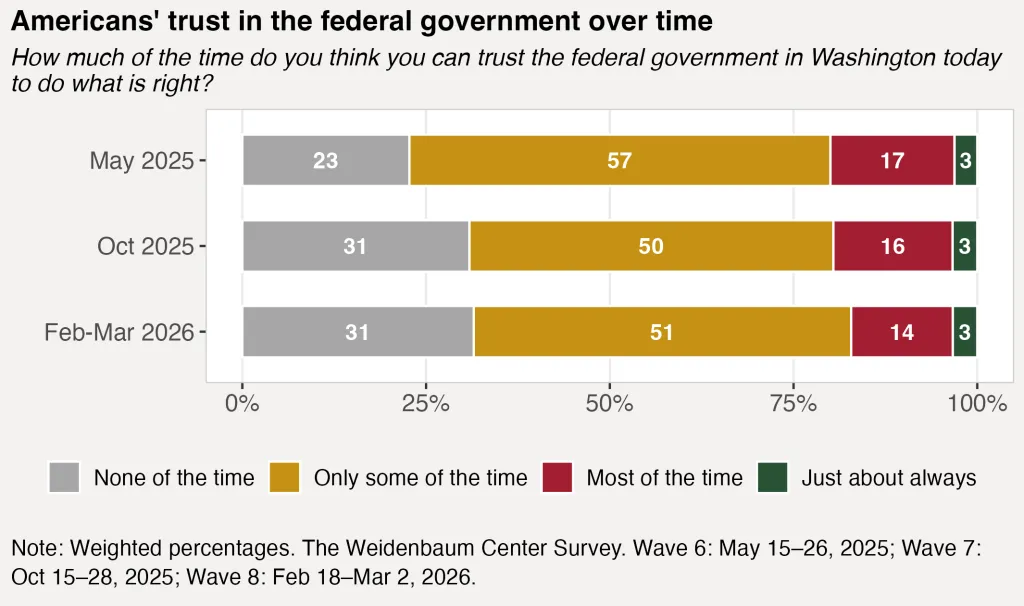
Levels of trust in the federal government have recently been quite low, as shown in the Weidenbaum Center Survey. Using the standard question from prior research (e.g., Hetherington & Rudolph 2015), participants were asked how much they trust the federal government to do what is right. Between May 2025 (Wave 6) and March 2026 (Wave 8), the share of Americans who say they trust the federal government “most of the time” or “just about always” remained persistently low (17-20%). The patterns closely mirror what was found in Pew Research Center’s 2025 report (Pew Research, 2025).
To unpack the patterns underlying overall levels of trust, the figure below shows how trust in the federal government differs across partisan groups. The vertical bars—95% confidence intervals—indicate the range of uncertainty around each estimate. When those bars do not overlap, it suggests that the differences between groups are large enough that they are unlikely to be due to chance.

Trust in the federal government appears highly conditional on individuals’ partisan affiliation. From May 2025 to March 2026, Republicans are consistently more likely than Democrats or Independents to express higher levels of trust in the federal government. Among Republicans, the share of those who express high trust in the federal government—those who say “just about always” or “most of the time”—rose to 34% in October 2025 before declining to 27% by March 2026. In contrast, the share of those with high trust has remained consistently low among both Democrats (9-14%) and Independents (9-12%).
These findings are consistent with prior research showing that partisans tend to trust the government more when their own party is in power (Bisgaard 2015; Hetherington & Rudolph 2015). For instance, during the Obama administration, the pattern was reversed: approximately 30% of Democrats expressed high trust in the federal government, whereas only 10% of Republicans expressed high trust (Hetherington & Rudolph 2015; p. 9).
At the same time, comparison with the longer-term trends suggests a broader decline in trust in the federal government. In the 1960s, more than 60% of both Democrats and Republicans reported high trust in the federal government (Hetherington & Rudolph 2015; p. 9). By contrast, the 2025–2026 WCS data indicate substantially lower levels of trust among both Democrats and Republicans. Even at its peak, the share of Republicans expressing high trust reaches only about one-third (34%), falling short of historically high levels of trust in federal government.
How Much Do Americans Trust Different Institutions?
As Hibbing and Theiss-Morse (1995) suggested, each institution tells a different story. The Wave 8 Weidenbaum Center Survey asked how much trust individuals have in five institutions: the presidency, Congress, the news media, local government, and the military. Consistent with what Gallup’s 2025 report (Brenan 2025) found, the results reveal a hierarchy of institutional trust rather than a uniform decline.
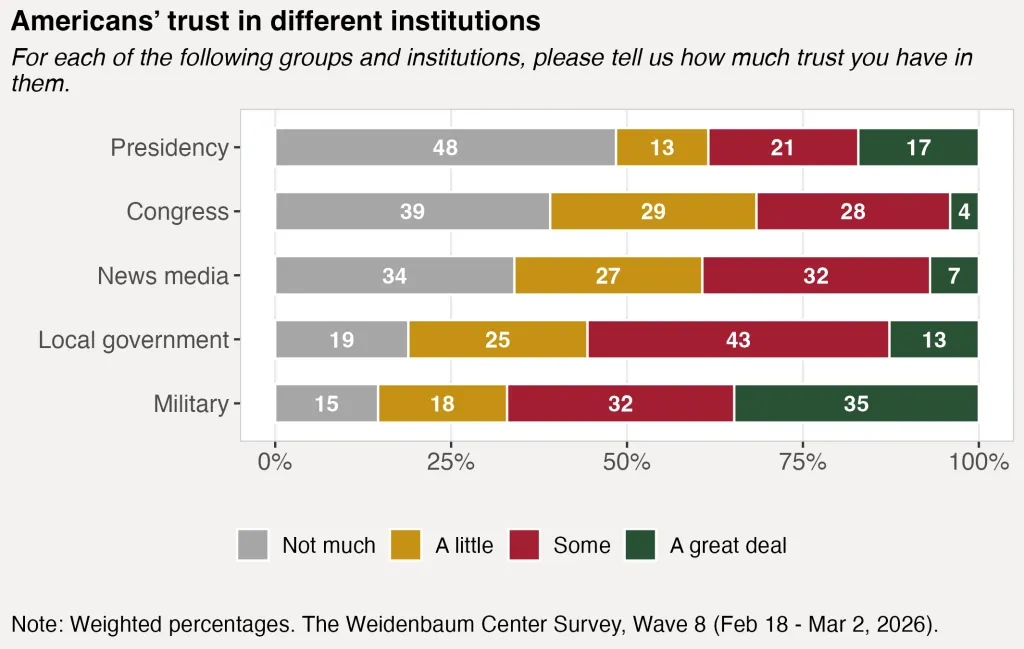
At the top of this hierarchy sit the military and local government. 67% of Americans express high trust—saying that they have “some” or “a great deal” of trust—in the military, making it the most trusted institution among those examined. Local government also maintains a relatively strong reservoir of goodwill, with 56% expressing at least “some” trust. These institutions, while not entirely insulated from national politics, are often perceived as more functional, less partisan, and closer to citizens’ everyday lives.
In contrast, trust drops sharply for national political institutions and the media. Only 38% of Americans express high trust—“some” or “a great deal” trust—in the presidency, followed closely by the news media, where 39% of Americans express high trust. Congress ranks at the bottom, with just 32% expressing high trust. These institutions are more directly associated with national politics and partisan conflict.
These results imply that Americans tend to place greater trust in institutions that are either less visibly partisan or more locally grounded (military, local government), while expressing greater skepticism toward the core institutions of national governance (the presidency, Congress) and the primary intermediary institution that connects citizens to politics (the media).
Along What Cleavages Do Americans Diverge in Their Trust in Institutions?
The WCS Wave 8 data further reveal not simply that trust is low, but that it is unevenly distributed. The results indicate that trust in institutions varies across three key cleavages: partisanship, geography, and economic security.
Institutional trust is sharply divided along partisan lines. The figure below shows the share of each partisan group reporting high trust—“some” or “a great deal” of trust—in each institution. The presidency reveals the sharpest partisan gap: 75% of Republicans express trust, compared to just 9% of Democrats. The pattern reverses for the news media, with 55% of Democrats trusting it, whereas only 23% of Republicans trust it. Even the military, long considered one of the least politicized institutions, shows signs of partisan differences, with 87% of Republicans expressing trust compared to 54% of Democrats. Independents tend to fall between the two parties across institutions, and their trust levels remain relatively low. These patterns suggest that Americans are not uniformly losing faith in institutions. Rather, they are reallocating trust based on partisan alignment.

Beyond partisanship, geography adds another layer to how much Americans trust institutions. The figure below shows that trust differs between urban and rural residents—but only for some institutions. Rural residents are more likely to express high trust—a great deal or some trust—in the military (73% vs. 64%) and the presidency (42% vs. 37%). By contrast, urban residents are more likely to report high trust in the news media (42% vs. 34%). For Congress and local government, however, nearly identical shares of urban and rural residents express high trust. Overall, urban-rural gaps in institutional trust are found in the presidency, the news media, and the military, but not in Congress and local government.

Not only does Americans’ trust in their fellow citizens vary between urban-rural areas (Silver et al. 2025), but their trust in certain institutions varies across regions as well. These patterns may reflect differences in how urban and rural residents perceive their interests to be represented across institutions (Mettler & Brown 2022). These differences may have implications to broader politics, such as how citizens respond to national politics. If rural residents place more trust in the presidency, they may be more receptive to executive action, while urban residents’ relatively higher trust in the news media could influence how they evaluate political information.
Employment status—one indicator of job security and closely tied to individuals’ pocketbook concerns—is also related to institutional trust. While Wroe (2015) suggests that perceptions of economic insecurity and political trust are generally negatively correlated, this relationship can vary across institutions. Employed individuals are more likely to express high trust in the presidency compared to unemployed individuals (39% vs. 32%), local government (57% vs. 51%), and the military (66% vs. 57%). However, this pattern reverses for Congress and the news media, where unemployed individuals report slightly higher trust than unemployed individuals (36% vs. 30% for Congress; 43% vs. 37% for news media).

These differences suggest that economic security does not uniformly increase trust, but instead shapes how individuals evaluate different parts of the political system. Those with a job may be more inclined to trust executive and administrative institutions, while those facing economic precarity may place relatively greater trust in representative or informational channels. In this sense, economic insecurity does not simply reduce trust—it redistributes it across institutions in ways that reflect individuals’ circumstances.
In Closing
Taken together, the findings from the Weidenbaum Center Survey, Waves 6–8, suggest that the “crisis of democracy” in 2026 is not simply a story of vanishing trust, but one of fragmentation. Trust is not a shared nationwide currency. Instead, it diverges along partisan and social lines. These divides are most pronounced in institutions at the center of national politics—such as Congress, the presidency, and the news media—that link citizens and political elites and shape how the public understands broader politics. In other words, trust in institutions is not just about how institutions perform, but is also filtered through lived experience—political, geographic, and economic.
When trust in these institutions lacks bipartisan, broad-based support, it becomes harder for political “losers” to accept outcomes and remain invested in the system. In that sense, institutional trust provides common ground across partisan and social cleavages that allows democracy to function and weather difficult moments. As trust becomes contingent on who holds power, institutions will struggle to command legitimacy across electoral cycles. If individuals trust institutions only when their side is in control or when government policies benefit themselves, the willingness to accept collective decisions and comply with the rules of the game becomes more fragile, especially during periods of political turbulence.
Declining trust in institutions also likely weakens the “diffuse support” that sustains democracy—citizens’ faith in democratic systems even when they disagree or are dissatisfied with specific outcomes (Easton 1965). Rebuilding a baseline of bipartisan and broadly shared institutional trust might not simply be a normative aspiration, but a practical condition for democratic stability.
Author
Hwayong Shin is a postdoctoral fellow at the Weidenbaum Center on the Economy, Government, and Public Policy at Washington University in St. Louis.
Acknowledgement
I am grateful to Taylor Carlson and Lukas Alexander for constructive and helpful comments.
Bibliography
Bisgaard, Martin. 2015. “Bias Will Find a Way: Economic Perceptions, Attributions of Blame, and Partisan-Motivated Reasoning during Crisis.” The Journal of Politics 77(3): 849–60. doi:10.1086/681591.
Citrin, J., & Stoker, L. (2018). Political Trust in a Cynical Age. Annual Review of Political Science, 21(Volume 21, 2018), 49–70. https://doi.org/10.1146/annurev-polisci-050316-092550
Dalton, R. J. (2017). Chapter 23: Political trust in North America. In Tom W. G. Van der Meer and Sonja Zmerli (eds) Handbook on Political Trust. Cheltenham and Northampton: Edward Elgar, pp. 375–395. https://www.elgaronline.com/edcollchap/book/9781782545118/book-part-9781782545118-35.xml
Devine, D. (2024). Does Political Trust Matter? A Meta-analysis on the Consequences of Trust. Political Behavior, 46(4), 2241–2262. https://doi.org/10.1007/s11109-024-09916-y
Devine, D., & Valgarðsson, V. O. (2024). Stability and change in political trust: Evidence and implications from six panel studies. European Journal of Political Research, 63(2), 478–497. https://doi.org/10.1111/1475-6765.12606
Easton, D. (with Internet Archive). (1965). A systems analysis of political life. New York, Wiley. http://archive.org/details/systemsanalysiso00east
Hetherington, M. J. (1998). The Political Relevance of Political Trust. American Political Science Review, 92(4), 791–808. https://doi.org/10.2307/2586304
Hetherington, M. J., & Rudolph, T. J. (2015). Why Washington Won’t Work: Polarization, Political Trust, and the Governing Crisis. University of Chicago Press. https://press.uchicago.edu/ucp/books/book/chicago/W/bo21516007.html
Hibbing, J. R., & Theiss-Morse, E. (1995). Congress as Public Enemy: Public Attitudes toward American Political Institutions. Cambridge University Press. https://doi.org/10.1017/CBO9781139174466
Kingzette, J., Druckman, J. N., Klar, S., Krupnikov, Y., Levendusky, M., & Ryan, J. B. (2021). How affective polarization undermines support for democratic norms. Public Opinion Quarterly, 85(2), 663-677. https://doi.org/10.1093/poq/nfab029
Kirk, J. R. G. (2025). Landscape of Distrust: Political Trust Across America’s Urban-Rural Divide. American Politics Research, 53(1), 28–35. https://doi.org/10.1177/1532673X241273220
Klymak, M., & Vlandas, T. (2025). Conflict Abroad and Political Trust at Home: Evidence from a Natural Experiment. British Journal of Political Science, 55, e17. https://doi.org/10.1017/S0007123424000838
Levitsky, S., & Ziblatt, D. (2019). How Democracies Die. Crown. https://www.penguinrandomhouse.com/books/562246/how-democracies-die-by-steven-levitsky-and-daniel-ziblatt/
Megan, B. (2025, July 17). Democrats’ Confidence in U.S. Institutions Sinks to New Low. Gallup.Com. https://news.gallup.com/poll/692633/democrats-confidence-institutions-sinks-new-low.aspx
Mettler, S., & Brown, T. (2022). The growing rural-urban political divide and democratic vulnerability. The ANNALS of the American Academy of Political and Social Science, 699(1), 130-142. https://doi.org/10.1177/00027162211070061
Palacios, I. (2025). How democratic backsliding and populism affect trust in democratic institutions. Democratization, 32(8), 1827–1850. https://doi.org/10.1080/13510347.2025.2494246
Pew Research Center. (2025, December 4). Public Trust in Government: 1958-2025. Pew Research Center. https://www.pewresearch.org/politics/2025/12/04/public-trust-in-government-1958-2025/
Silver, L., Keeter, S., Kramer, S., Lippert, J., Ramones, S. H., Cooperman, A., Baronavski, C., Webster, B., Nadeem, R., & Chavda, J. (2025, May 8). Americans’ Declining Trust in Each Other and Reasons Behind It. Pew Research Center. https://www.pewresearch.org/2025/05/08/americans-trust-in-one-another/
Valgarðsson, V., Jennings, W., Stoker, G., Bunting, H., Devine, D., McKay, L., & Klassen, A. (2025). A Crisis of Political Trust? Global Trends in Institutional Trust from 1958 to 2019. British Journal of Political Science, 55, e15. https://doi.org/10.1017/S0007123424000498
van der Meer, T. W. G. (2017). Political Trust and the “Crisis of Democracy.” In E. Hannah (Ed.), Oxford Research Encyclopedia of Politics (p. 0). Oxford University Press. https://doi.org/10.1093/acrefore/9780190228637.013.77
Wroe, A. (2016). Economic Insecurity and Political Trust in the United States. American Politics Research, 44(1), 131–163. https://doi.org/10.1177/1532673X15597745
Data
The Weidenbaum Center Survey (WCS), Waves 6–8 were conducted by Washington University in St. Louis's Weidenbaum Center on the Economy, Government, and Public Policy through the survey firm YouGov (Wave 6: May 15–26, 2025; Wave 7: October 15–28, 2025; Wave 8: February 18 – March 2, 2026). The sample size for each wave was: Wave 6 (n = 3,535), Wave 7 (n = 3,029), and Wave 8 (n = 3,367). For each figure, respondents with missing responses on the relevant variable(s) were excluded from the corresponding analysis. Because there was an oversample of African Americans, the weighted percentages were presented in the results. The number of respondents by partisanship is as follows: 1,838 Democrats, 919 Republicans, 692 Independents (Wave 6), 1,577 Democrats, 755 Republicans, 622 Independents (Wave 7), and 1,755 Democrats, 886 Republicans, 643 Independents (Wave 8). For partisan identity, “Democrats” include individuals identifying as Strong Democrat, Not very strong Democrat, or Lean Democrat; “Republicans” include those identifying as Strong Republican, Not very strong Republican, or Lean Republican; and “Independents” refer to pure independents who identified as Independent without partisan leaning. In Wave 8, the number of respondents by residence area is: 2448 Urban (“City” or “Suburb”), 898 Rural (“Town” or “Rural area”). In Wave 8, the number of respondents by employment status is: 1,462 Employed (“Full-time” or “Part-time”), 382 unemployed (“Temporarily laid off” or “Unemployed”); respondents who were retired, disabled, homemakers, students, or selected "other" were excluded from these categories.