
Weidenbaum Center Graduate Research Affiliate, Lukas Alexander, Publishes New Research on Presidential Power
Lukas Alexander, Weidenbaum Center Graduate Research Affiliate
September 24th, 2026
Abstract
Existing accounts of presidential particularism emphasize the targeted distribution of benefits to electorally valuable constituencies. This research note demonstrates that presidential particularism can also operate punitively, through the selective imposition of costs on constituencies that provided weaker electoral support for the president. I examine this dynamic through the Department of Government Efficiency (DOGE), a highly centralized and politicized agency created at the start of Donald Trump’s second term. Leveraging data on nearly 700,000 federal contracts linked to DOGE contract cuts and 2024 county-level election returns, I show that these cuts were systematically concentrated in counties that provided weaker electoral support for Trump. These patterns hold across contract- and county-level analyses. Together, these findings broaden theories of presidential particularism by showing that presidents may use administrative authority to impose costs on electorally oppositional constituencies. More broadly, I demonstrate how presidents can wield administrative power as a tool of partisan punishment.
In early 2025, at the beginning of President Donald Trump’s second term, the White House issued an executive order creating the Department of Government Efficiency (DOGE) (Trump Reference Trump2025). Charged with enhancing federal efficiency and productivity, DOGE quickly launched sweeping initiatives to eliminate what the administration labeled as bureaucratic waste. This included cutting federal contracts (Nguyen and Blaeser Reference Nguyen and Blaeser2025), initiating mass layoffs of federal employees (Cameron Reference Cameron2025), and expanding oversight and surveillance of civil servants (Shear, Barnes, and Schmitt Reference Shear, Barnes and Schmitt2025). Although presented as a neutral technocratic reform, I present evidence that DOGE’s actions were politically structured, providing President Trump with an instrument to impose targeted harm on communities that had not supported him electorally.
In this research note, I argue that presidential particularism extends beyond the unequal distribution of benefits to include the imposition of costs. Existing research shows that presidents allocate federal resources to reward electorally valuable constituencies, such that politically aligned areas receive more benefits while unaligned areas receive fewer by comparison (Berry, Burden, and Howell Reference Berry, Burden and Howell2010; Ha Reference Ha2023; Kriner and Reeves Reference Kriner and Reeves2015b). In this framework, disadvantage arises passively as a byproduct of preferential allocation.
I build on this literature by showing that presidential particularism can operate through a distinct punitive dimension. Rather than merely receiving fewer benefits, disfavored constituencies may be directly targeted with costs. This distinction matters because withholding or limiting particularistic benefits produces a passive form of disadvantage, whereas the imposition of costs involves active harm that may signal punishment or retribution. This logic aligns with prospect theory, which demonstrates that individuals evaluate gains and losses asymmetrically, with losses experienced more intensely than equivalent gains (Kahneman and Tversky Reference Kahneman and Tversky1979). I argue that this punitive form of presidential particularism helps explain DOGE’s behavior, demonstrating that presidential particularism operates not only through the distribution of resources but also through the imposition of costs.
From this perspective, DOGE was not merely a technocratic agency tasked with eliminating redundancy; it functioned as an instrument of partisan discipline. Viewed through the lens of presidential particularism, DOGE provides evidence that presidents may use the machinery of federal administration to penalize political opposition rather than govern in a neutral, universalistic manner. This perspective broadens the study of distributive politics beyond the “carrot” of reward-based presidential particularism to include the “stick” of targeted harm. By incorporating punishment alongside reward, this framework expands existing theories of presidential particularism to encompass the targeted distribution of administrative harm.
Emerging work on DOGE provides additional context for understanding its political implications. Bellodi and Lee (Reference Bellodi and LeeN.d.) analyze the distribution of DOGE contract cuts and show that firms donating to the Republican Party were less likely to experience contract cuts, while those donating to the Democratic Party were more likely. Similarly, in a blog post, Bonica (Reference Bonica2025) argues that DOGE’s actions reflect political considerations rather than purely technocratic objectives, demonstrating that more liberal agencies were disproportionately affected by layoffs. Together, these findings suggest that DOGE’s activities were structured by political incentives. This study builds on this emerging literature by shifting the focus to the geographic distribution of harm, showing how presidential particularism may operate punitively across electorally defined constituencies.
If presidential particularism extends to the imposition of costs, it should be most observable in institutional settings characterized by strong presidential control such as the conditions exemplified by DOGE. Created by executive order and housed within the Executive Office of the President, the agency was granted substantial authority to determine which contracts to cut and operated in close coordination with the White House (Trump Reference Trump2025). Its structure reflects a broader pattern identified in the literature: modern presidents consolidate influence over the bureaucracy through centralization and politicization (Moe Reference Moe, Chubb and Peterson1985). As Moe (Reference Moe, Chubb and Peterson1989) argues, bureaucratic structures are crafted not to maximize administrative efficiency, but to advance political objectives. Presidents seek institutional arrangements that enhance their capacity to shape implementation and maintain control over policy outcomes (Moe Reference Moe, Chubb and Peterson1989, 280). This pattern is consistent with prior work showing that more politicized agencies distribute contracts and engage in favoritism toward electorally important constituencies (Dahlström, Fazekas, and Lewis Reference Dahlström, Fazekas and Lewis2021; Gordon Reference Gordon2011). Viewed in this light, DOGE’s institutional design was not incidental. By consolidating presidential control (Marisam Reference Marisam2025), DOGE created channels through which presidential priorities could be embedded directly within the administrative state. This structure increased the likelihood that bureaucratic action would reflect the president’s particularistic incentives rather than operate independently of them. Given DOGE’s distinctive institutional position, it represents a case in which we would expect presidential particularism to be especially pronounced, due to its high levels of centralization and politicization.
These institutional dynamics operate within a broader context of high levels of elite polarization. As partisan elites have become more ideologically divided (McCarty, Poole, and Rosenthal Reference McCarty, Poole and Rosenthal2016), the presidency has faced new demands and expectations (Lowande Reference Lowande2024). One consequence is the rise of “negative representation,” where politicians prioritize attacking the opposing party over advancing their own agenda (Costa Reference Costa2025). While presidents have long used administrative tools to reward allies, elite polarization may increase the incentives of using those same tools to punish supporters of the opposing party. This alternative conceptualization of presidential particularism as punitive broadens how we conceptualize presidential representation.
Notably, a punitive dimension of presidential particularism runs against foundational theories of presidential incentives. The idea that presidents would intentionally impose material harm on specific constituencies conflicts with the logic of retrospective voting. In classic accounts, citizens evaluate incumbents largely on economic performance, rewarding good outcomes and punishing poor ones (Fiorina Reference Fiorina1981; Key Reference Key1966; Kramer Reference Kramer1971; Lewis-Beck and Stegmaier Reference Lewis-Beck and Stegmaier2000). Because voters are presumed to engage in pocketbook evaluations, presidents are expected to maximize broad economic well-being rather than selectively impose costs. Indeed, Tufte (Reference Tufte1980) argues that incumbents strategically manipulate economic conditions to improve their electoral prospects. This logic—that voters reward economic performance—has also underpinned explanations for why politicians engage in pork-barrel politics, directing targeted benefits to constituents in hopes of securing electoral support (Hudak Reference Hudak2014; Stein and Bickers Reference Stein and Bickers1994). Against this backdrop, the strategic deployment of targeted harm appears electorally risky. In an era of intense partisan polarization, however, a punitive dimension of presidential particularism may reflect a shift in incentive structures in which mobilizing and consolidating a partisan coalition outweighs the traditional imperative to deliver universalistic economic gains.
To assess this punitive dimension of presidential particularism, I analyze DOGE during the early months of Trump’s second term. I assemble a dataset of nearly 700,000 federal contracts active at the start of the second Trump administration and matched them to contracts cut by DOGE. Each contract is geocoded to the recipient’s county and linked to 2024 county-level presidential election returns, enabling fine-grained analyses at both the contract and county levels.
The results support expectations generated by an expanded understanding of presidential particularism as a punitive, rather than purely reward-based, strategy. Contracts in counties that provided weaker electoral support for Trump in 2024 were significantly more likely to be cut. Moreover, counties with lower levels of electoral support for Trump experienced a significantly greater expected number of DOGE contract cuts. I demonstrate these contract- and county-level patterns using both a continuous measure of 2024 county-level vote share and a categorical classification of counties, with results remaining consistent across model specifications.
These findings contribute to the study of executive politics by expanding the concept of presidential particularism beyond its traditional focus on rewarding allies. While prior work shows that presidents use distributive tools to benefit supporters (Ha Reference Ha2023; Kriner and Reeves Reference Kriner and Reeves2015a; Reference Kriner and Reeves2015c), this study demonstrates that the same tools can be deployed to inflict targeted harm. In certain institutional settings, such as those exemplified by DOGE, the modern presidency can administer punishment. This case highlights how the punitive form of presidential particularism can emerge in the wake of an election and highlights an instance in which presidential particularism operates as a mechanism of retributive governance.
Situated within an environment of heightened elite polarization (Enders Reference Enders2021; Hetherington Reference Hetherington2001; McCarty, Poole, and Rosenthal Reference McCarty, Poole and Rosenthal2016; Theriault Reference Theriault2008), and given the president’s increasingly central role in party politics (Alexander and Jacobs Reference Alexander and Jacobs2023; Galvin Reference Galvin2009; Jacobs and Milkis Reference Jacobs and Milkis2021; Jacobson Reference Jacobson2019), these results suggest that presidential power can become an extension of partisan conflict. As such, presidential power may function not only as a tool of governance but also as a mechanism of partisan punishment, shaping how benefits and burdens are distributed across constituencies.
Presidential Particularism as Punitive
Presidential particularism has traditionally been understood as a strategy of reward: presidents direct federal resources toward electorally valuable constituencies in order to consolidate support and enhance political standing (Kriner and Reeves Reference Kriner and Reeves2015a). I extend this framework by arguing that the same incentives that motivate targeted rewards can also motivate targeted punishment. This theoretical expansion builds directly on the literature on presidential particularism, which conceptualizes it as the strategic allocation of federal benefits to electorally valuable constituencies. As theorized by Kriner and Reeves (Reference Kriner and Reeves2015a), presidential particularism reflects the president’s dual role as both national executive and partisan leader, uniquely positioned to deploy federal resources for political gain. This perspective aligns with a broader literature emphasizing the presidency’s institutional centrality in advancing partisan objectives (Galvin Reference Galvin2009; Milkis, Rhodes, and Charnock Reference Milkis, Rhodes and Charnock2012; Wood Reference Wood2009). Distributive benefits in this framework serve both material and symbolic functions, shaping public perceptions and influencing presidential approval (Ang et al. Reference Ang, Reeves, Rogowski and Vishwanath2022; Cohen Reference Cohen2006; Gasper and Reeves Reference Gasper and Reeves2011).
Empirical evidence demonstrates that presidential particularism is a routine feature of executive governance. Kriner and Reeves (Reference Kriner and Reeves2015b) show that presidents systematically direct domestic grants toward politically valuable counties, with similar patterns documented in trade protection (Lowande, Jenkins, and Clarke Reference Lowande, Jenkins and Clarke2018) and COVID-19 relief allocation (Ha Reference Ha2023). While this literature overwhelmingly focuses on the rewarding of political allies, the same institutional tools can plausibly be used to punish political opponents.
Existing work has only indirectly engaged with this possibility. Studies of military base closures note instances in which presidential particularism could have operated punitively (Kriner and Reeves Reference Kriner and Reeves2015a; Reference Kriner and Reeves2015c). However, as Kriner and Reeves (Reference Kriner and Reeves2015a) emphasize, the most explicit example—Dick Cheney’s proposal to target partisan opponents through base closures—was never implemented. As a result, the punitive dimension of presidential particularism has received limited direct empirical attention, particularly with respect to its real-world operation and geographic consequences. Insights from prospect theory highlight why the administration of punishment is especially consequential: individuals are loss averse and evaluate losses more negatively than comparable gains (Kahneman and Tversky Reference Kahneman and Tversky1979). Consequently, policies that impose costs are likely to be highly salient and politically meaningful, underscoring the importance of examining how presidents may deploy punishment as a particularistic strategy.
This study extends the logic of presidential particularism by examining its punitive form: how presidents may use executive authority to impose costs on electorally oppositional constituencies. Underlying this behavior is a dual reality—presidents are both uniquely empowered to shape the flow of federal resources and politically incentivized to wield that authority for partisan advantage.
A growing body of scholarship underscores the structural dominance of the presidency in both federal policymaking and partisan politics. Presidents have expansive unilateral powers that allow them to shape public policy with minimal legislative constraint (Childree Reference Childree2025; Howell Reference Howell2003). In addition to formal unilateralism, the president leads the federal bureaucracy, a domain where the vast majority of major laws delegate implementation authority, thus amplifying executive discretion (McCann, Clouser, and Shipan Reference McCann, Clouser and Shipan2022; VanSickle-Ward Reference VanSickle-Ward2014). The centralized and politicized bureaucracy over which presidents exercise authority (Moe Reference Moe, Chubb and Peterson1985) underscores their substantial institutional power within the federal government.
Presidents are also central to partisan strategy and representation. As leaders of their parties, presidents shape electoral strategies, party branding, and legislative positioning (Galvin Reference Galvin2009; Jacobs and Milkis Reference Jacobs and Milkis2021; Milkis and Jacobs Reference Milkis and Jacobs2017). Public perception of the president often extends to their party more broadly, influencing evaluations of co-partisans and shaping down-ballot electoral outcomes (Jacobson Reference Jacobson2019). Moreover, presidents have become so central to partisan politics that legislators increasingly look to them for cues on policy positions and legislative strategy (Alexander and Jacobs Reference Alexander and Jacobs2023). The nationalization of American politics has only magnified the importance of presidents, making presidential support increasingly synonymous with party performance (Hopkins Reference Hopkins2018; Rogers Reference Rogers2023).
While institutional and partisan centrality has led scholars to focus on the president’s capacity to reward allies, the same logic extends to punishment. The very mechanisms that sustain presidential particularism also enable presidents to engage in punitive behavior. At the elite level, polarization has intensified the stakes of partisan conflict. Over the past several decades, party leaders have diverged not only in policy preferences but also in governing styles and institutional strategies (McCarty, Poole, and Rosenthal Reference McCarty, Poole and Rosenthal2016; Theriault Reference Theriault2008). As elites have grown more polarized, cooperation in Congress has eroded, and institutional gridlock has deepened, placing greater weight on presidents (Lowande Reference Lowande2024). In this environment, presidents face both heightened incentives and fewer constraints to use administrative power not only to cultivate allies, but to penalize opponents.
In this context, presidents—who serve both as national executives and party leaders—may come to see the exercise of administrative power as an extension of partisan conflict. Rather than governing in a universalistic manner, they may advance the interests of their partisan coalition while actively disadvantaging the opposing side. This perspective aligns with emerging research on negative representation, which highlights how politicians increasingly define their actions not by responsiveness to constituents but by hostility toward the out-party (Costa Reference Costa2025). Negative representation has been most visible in rhetoric and symbolic acts, but it also has potential material implications.
This research note argues that presidents can institutionalize partisan hostility by embedding it within the administrative apparatus of government. Through the selective imposition of harm—such as cutting contracts—presidents may convert the federal bureaucracy into a tool of partisan punishment. Crucially, unlike traditional discretionary spending programs where presidents aim to maximize distribution in politically advantageous ways, DOGE faced no fixed threshold for required cuts. This lack of constraint made its decisions over where and how to impose harm particularly susceptible to political considerations.
To provide preliminary descriptive support for the argument that presidential particularism can operate in a punitive form, I present a bivariate scatterplot illustrating the relationship between a county’s Trump two-party vote share and the logged number of contracts cut by DOGE (plus one). As shown in Figure 1, the scatterplot includes a smoothed LOESS line to visualize the trend between electoral support and the geographic concentration of DOGE contract cuts.
Questions about the existence of God have occupied human thought for centuries, much as questions about individuals’ relationship to politics. For much of history—from Ancient Egypt and Imperial China to medieval Europe—religion served as a key source of political legitimacy, providing governments with moral authority and public support (Grzymala-Busse 2020; Hill et al. 2013; Zhao 2009). Although modern societies increasingly separated religion from politics and political institutions have become more secular (Brown 2019), religion continues to play an important role in our political life.
In the United States, religion remains deeply intertwined with politics. Recent research shows that Americans’ religiosity is closely linked to their political orientations, such as partisanship (Campbell et al. 2018). The relationship between religion and politics may also vary across age groups, as religious identities evolve over the life course and can themselves be shaped by politics (Bengston et al. 2015; Margolis 2018) At the same time, the country's religious landscape has changed with the rise of religious “nones”—people who do not identify with any religion but pray, believe in God, or engage in religious practices, and who exhibit distinct political orientations (Levin et al. 2022; Schwadel 2020). These developments raise an important question: how religious are Americans, and how does religiosity shape political attitudes in contemporary America?
One of the long-held questions in the study of religion and politics is whether religiosity shapes trust in government. The answer, surprisingly, is far from settled. Some scholars argue—and present evidence—that religiosity can discourage trust in government because many major religions emphasize loyalty to one's own community or encourage believers to solely place their trust in God (Berggren & Bjørnskov 2009; Valente & Okulicz-Kozaryn 2021). Other scholars reach an opposite conclusion, finding that secularization is associated with lower institutional trust—atheists and nonreligious individuals tend to express lower trust in government—and that religiosity is positively associated with trust in government (Creel 2021; Godefroidt et al. 2017; Kasselstrand et al. 2017).
Part of the reason for these mixed findings may be that religiosity is not a single-dimensional construct (Huber & Huber 2012; Joseph & DiDuca 2007). People may practice their faith in different ways, for instance, by attending religious services or praying privately (Gemar 2024; Valente & Okulicz-Kozaryn 2021). These different expressions of religiosity may carry different implications for political trust. Existing research suggests that communal and private religious practices are associated with trust in government in different ways. Attending religious services—a social or communal form of practice—has been linked to trust in institutions or other people, whereas praying—an individual or private form of practice—has been associated with lower trust (Gemar 2024; Valente & Okulicz-Kozaryn 2021). Understanding these different dimensions of religiosity is important for understanding how religion shapes Americans' political life and their trust in government today.
Data from the Weidenbaum Center Survey (WCS) offer new insights into Americans’ religious and political lives by addressing two broad questions. First, how religious are Americans today, and how does religiosity vary across age and partisan groups? Waves 1–8 of the WCS, conducted between 2023 and 2026, are used to answer this question. Second, how are different forms of religiosity associated with trust in government, and do these relationships differ across age and partisan groups? To answer this question, this article leverages Waves 6–8 of the WCS, which included measures of trust in government, conducted between 2025 and 2026. The findings shed new light on how both believing—praying privately—and belonging—attending religious services—relates to political trust in contemporary religious landscape of the United States.
How Religious Are Americans Today?
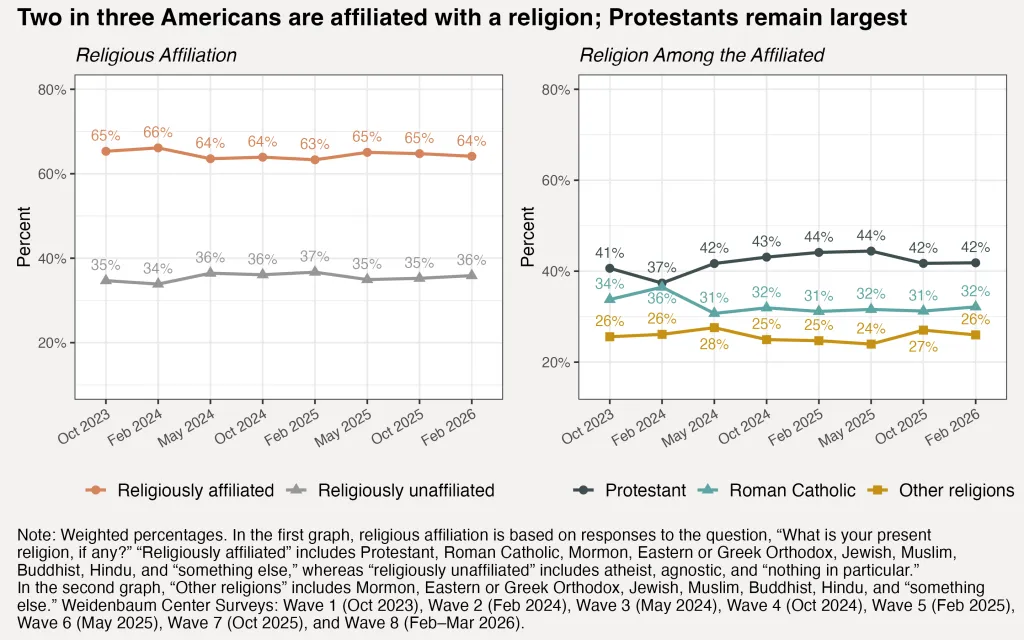
To examine Americans’ religious affiliation, respondents were asked to identify their current religion, if any. The distribution of religious affiliation remained quite stable between late 2023 and early 2026. Roughly one-third of Americans were religiously unaffiliated, identifying as atheist, agnostic, or “nothing in particular.” The remaining two-thirds identified with a religion, including Protestant, Roman Catholic, Mormon, Eastern or Greek Orthodox, Jewish, Muslim, Buddhist, Hindu, or another religion. These patterns are largely consistent with Gallup’s findings, which identify Protestants and Catholics as the largest religious groups in the United States, although the WCS estimates a larger share of religiously unaffiliated Americans than Gallup (22% in 2024; Jones 2025).
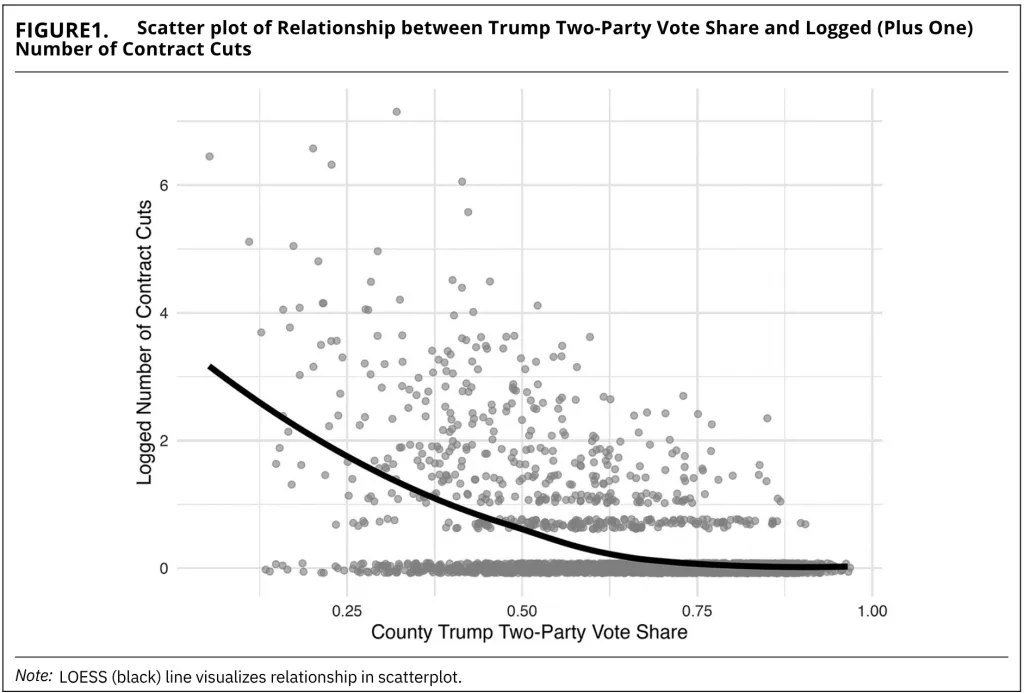
Figure 1: Long Description
The relationship is distinctly negative: counties that provided stronger electoral support for President Trump experienced fewer contract cuts, whereas those with lower levels of support faced more cuts. The Pearson correlation coefficient of
Data and Methods
While the bivariate scatterplot provides preliminary evidence of an association between Trump’s county-level electoral support and DOGE’s impact, the following section outlines the data and empirical strategy used to more rigorously evaluate the presence of a punitive dimension of presidential particularism.
To begin, I assemble a dataset of federal contracts that were plausibly eligible to be cut by DOGE. I draw contract-level data from the Federal Procurement Data System (2026), collecting all contracts entered between fiscal year 2004 and January 20, 2025—the inauguration date of Trump’s second term.Footnote 1 To be included, contracts must have originated within this period and have a scheduled completion date after inauguration day, ensuring that they were active at the start of the second Trump administration. These contracts constitute the federal contracts that could have theoretically been subject to cuts by DOGE, as they were initiated before the start of the administration and remained in progress.Footnote 2 In total, the resulting dataset contains nearly 700,000 federal contracts.
I next incorporate a dataset of federal contracts cut by DOGE during the first seven months of President Trump’s second administration. As of September 9, 2025, the DOGE website listed 13,231 contract cuts (Department of Government Efficiency 2025). With respect to data completeness, DOGE notes that reported contract cuts may be subject to delays due to lags in FPDS reporting. DOGE also indicates that the contract, grant, and lease cancellation information displayed on its website represents a subset of DOGE’s total reported savings, which also include additional components, such as workforce reductions and asset sales.Footnote 3Every possible DOGE contract cut was cross-referenced with the Federal Procurement Data System (2026). In total, the dataset comprises nearly 700,000 federal contracts eligible to be cut and includes a binary indicator identifying whether each contract was cut by DOGE.Footnote 4
I next incorporate a series of control variables. First, I assign each contract to a county based on its reported ZIP Code Tabulation Area (ZCTA). For each ZCTA, I calculate a centroid and match it to the county in which it is located. This procedure enables the linkage of each contract to a county-level dataset containing results from the 2024 U.S. presidential election.Footnote 5In addition to using Trump’s two-party vote share as a continuous independent variable, I also construct a three-category classification of counties as core, swing, or hostile, following prior work on presidential particularism (Kriner and Reeves Reference Kriner and Reeves2015a; Reference Kriner and Reeves2015b).Footnote 6
I then add county-level demographic characteristics drawn from the 2024 U.S. Census Bureau’s American Community Survey, including logged population, logged median household income, the percentage of adults without a high school diploma, and population density (U.S. Census Bureau 2026). Next, each county is associated with a congressional district by assigning it to the district covering the largest share of the county’s land. I include information on the county’s representative in the 119th Congress, focusing on the representative’s partisan relationship to the president.Footnote 7
Finally, I construct measures capturing the logged number of federal contracts awarded to each county between fiscal year 2004 and January 20, 2025, as well as the logged number of contracts awarded during the Biden administration.Footnote 8
To construct the county-level dataset, I aggregate the total number of DOGE-related contract cuts within each county. Counties with no reported DOGE contract cuts are assigned a value of zero. Counties that received no federal contracts between fiscal year 2004 and January 20, 2025 are assigned a value of zero for total contracts, and counties that received no federal contracts during the Biden administration are assigned a value of zero for Biden-era contracts.
In both the contract- and county-level analyses, the inclusion of the control variables described above helps isolate the relationship between Trump’s electoral support and DOGE’s contract cuts. For example, counties with lower levels of support for Trump may have historically received a greater volume of federal contracts, while more populous counties may mechanically experience larger numbers of cuts due to their larger contracting base. By accounting for these structural and contextual differences, the analysis provides an estimate of the relationship between electoral support for President Trump and the geographic distribution of DOGE-imposed contract cuts.
To evaluate this relationship, I employ complementary modeling strategies.
The first uses the contract-level dataset to examine the factors shaping the likelihood that an individual federal contract was cut by DOGE. I estimate logistic regression models appropriate for a binary outcome indicating whether a contract was cut by DOGE (1) or not (0). At the contract level, I estimate two sets of models that differ in how electoral support is operationalized. In the first set, the key independent variable is the county-level Trump two-party vote share in the 2024 election. These models include covariates capturing county-level socioeconomic and political context: logged population, logged median household income, the percentage of the population without a high school diploma, population density, an indicator for whether the county is represented by a co-partisan member of Congress, the logged total number of contracts awarded to the county between fiscal year 2004 and January 20, 2025, and the logged number of contracts awarded during the Biden administration. All models report standard errors clustered at the state level, and specifications are estimated both with and without state fixed effects.
In the second set of contract-level models, electoral support is measured categorically using county type—core, swing, or hostile—based on the 2024 Trump two-party vote share. Core counties serve as the reference category, with indicator variables for swing and hostile counties. The covariates, estimation strategy, and standard error clustering remain identical to those in the continuous vote-share models.
The next set of analyses parallels the contract-level approach but shifts the unit of analysis to the county level. Using the county-level dataset, I model the total number of DOGE contract cuts experienced by each county. Because the dependent variable is a count of the number of contract cuts, I estimate negative binomial regression models.
In the first set of county-level models, the key independent variable is the county’s Trump two-party vote share in the 2024 election, with the same set of control variables, state fixed effects, and state-clustered standard errors as in the contract-level analyses. In the second set, electoral support is operationalized using the county-type classification (core, swing, and hostile), again mirroring the controls and estimation strategy employed at the contract level.
By analyzing how presidential particularism may have manifested through the punitive use of DOGE contract cuts across the United States, this study leverages both contract- and county-level data to investigate the political logic underlying these administrative actions. Employing multiple levels of analysis and operationalizations of electoral support provides insight into the geographic and political contours of DOGE’s contract cuts. Together, these analyses provide a systematic test of whether presidential particularism extends beyond the distribution of benefits to include the targeted imposition of costs.Footnote 9
Among those who were religiously affiliated, Protestants consistently made up the largest group, accounting for about 40% of all affiliated respondents (37–44%). Roman Catholics were the second-largest group, comprising roughly 30% (31–36%). Each of the remaining religious traditions—including Mormon, Eastern or Greek Orthodox, Jewish, Muslim, Buddhist, Hindu, and other religions—represented less than 5% of affiliated respondents individually. Together, however, these groups accounted for about one-quarter of religiously affiliated Americans (24–28%).
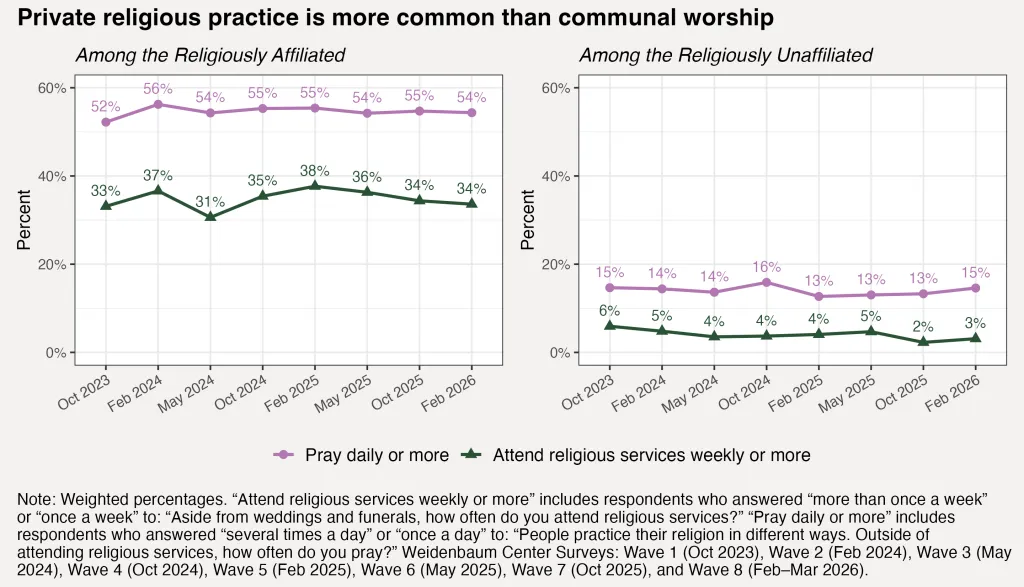
How often do Americans practice religion, either privately through prayer or socially by attending religious services? Among religiously affiliated Americans, about half (52–56%) pray at least once a day, while roughly one-third (31–38%) attend religious services at least once a week. Consistent with recent discussions of religious “nones” in the United States, some religiously unaffiliated Americans also engage in religious practices. Between 13% and 16% report praying at least once a day, while 2% to 6% attend religious services at least once a week.
When religious affiliation and practices are examined across age groups, the youngest (under 30) and oldest (60 or above) cohorts of Americans are most likely to have a religious affiliation (64% and 71%, respectively) compared with those in the middle age groups. The oldest cohort reports the highest rate of daily prayer (47%), whereas the youngest cohort has the largest share attending religious services weekly or more (32%). This pattern is consistent with recent findings that Americans who leave the religion in which they were raised tend to do so around age 30 (Alper et al. 2025), which may help explain the lower levels of religious affiliation and practice among adults ages 30–44.
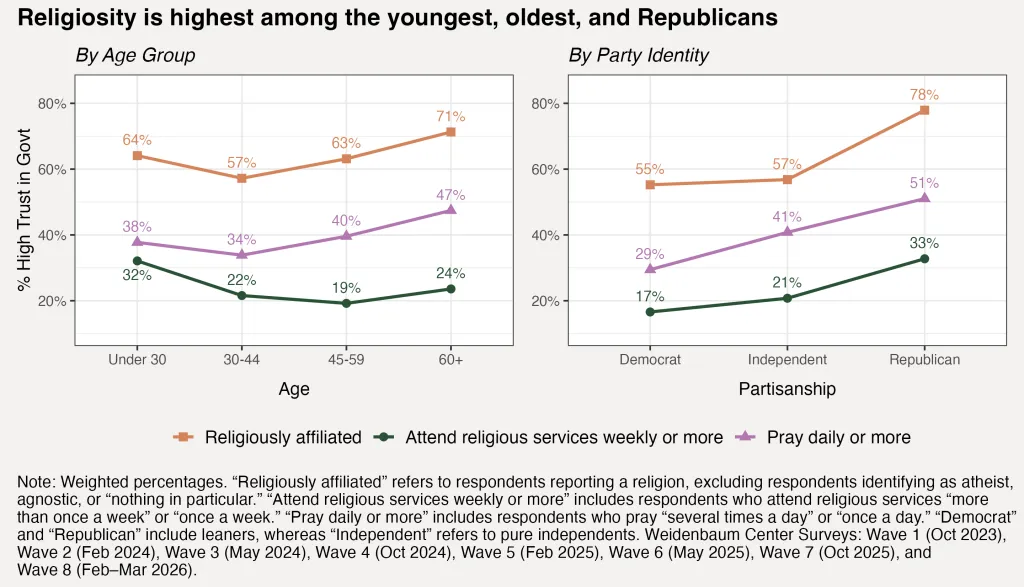
When partisan differences are considered, Republicans are the most religious across all three aspects of religiosity, reporting the highest rates of religious affiliation (78%), daily prayer (51%), and regular attendance at religious services (33%). Independents fall in the middle, while Democrats are the least religious in terms of both affiliation and religious practice. These patterns are consistent with recent research showing that Republicans are more religious than Democrats across multiple dimensions of religiosity (Diamant 2025).
How Are Social and Private Religious Practices Linked to Trust in Government?
Trust in federal government—the extent to which respondents trust the federal government to do what is right—is examined using Waves 6-8 of WCS. Prior research comparing social and private forms of religious practices has found contrasting relationships with institutional and social trust. Specifically, attending religious services has been associated with higher levels of trust, whereas private prayer has been linked to lower trust in democratic institutions (e.g., Congress), religious institutions, and interpersonal or generalized trust (Gemar 2024; Valente & Okulicz-Kozaryn 2021). Do these two forms of religious practices exhibit similar or divergent relationships with trust in the federal government?
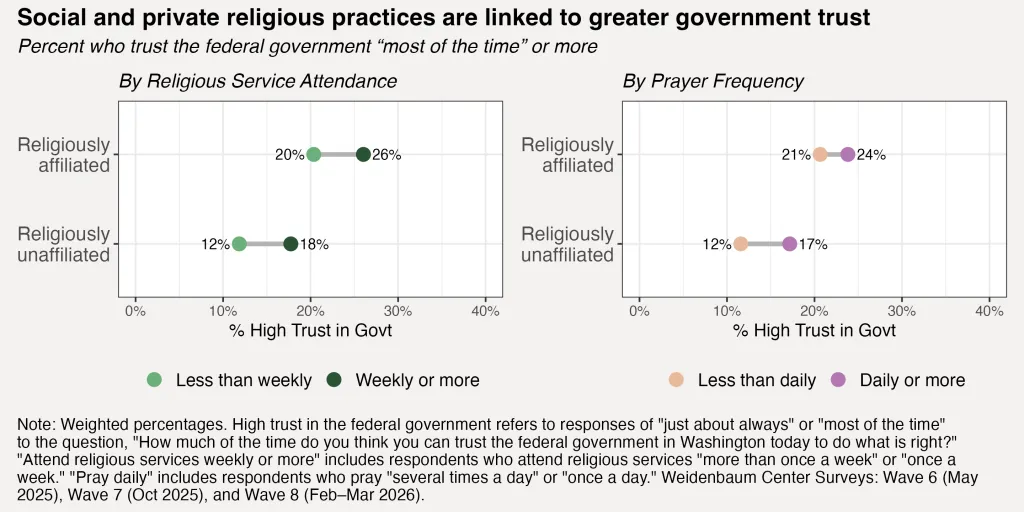
In the graphs below, high trust in the federal government is defined as respondents reporting that they trust the federal government to do what is right “just about always” or “most of the time.” Different from previous findings for institutional trust and generalized trust, trust in the federal government is positively associated with both social and private religious practices. Among religiously affiliated Americans, 26% of those who attend religious services at least weekly report high trust in the federal government, compared with 20% of those who attend less frequently. Likewise, 24% of those who pray daily or more report high trust, compared with 21% of those who pray less often. These relationships are similarly found among religiously unaffiliated Americans: weekly religious service attendance is associated with a 6-percentage-point increase in high trust (12% vs. 18%), while daily prayer is associated with a 5-percentage-point increase (12% vs. 17%).
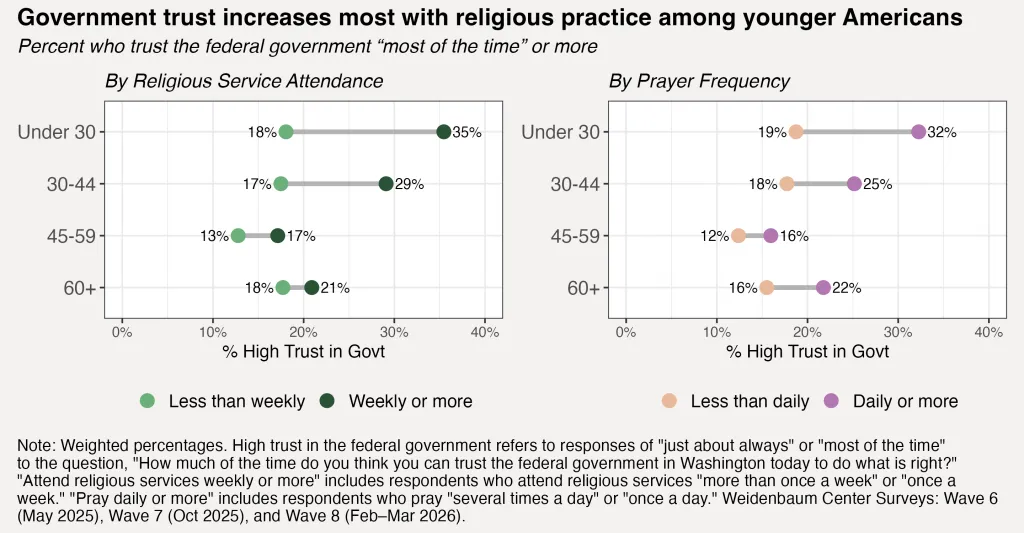
The relationship between religious practice and trust in the federal government is broadly consistent across age groups, although its strength varies. Because some religiously unaffiliated Americans also engage in religious practices, the analysis below compares respondents by their religious practices regardless of religious affiliation. Across all age cohorts, both regular religious service attendance and daily prayer are associated with higher levels of trust in the federal government. The association is strongest among the youngest Americans (under 30): weekly religious service attendance is associated with a 17-percentage-point increase in high trust (18% vs. 35%), while daily prayer is associated with a 13-percentage-point increase (19% vs. 32%). The positive relationship also holds among older age groups, although the magnitude of the differences is smaller.
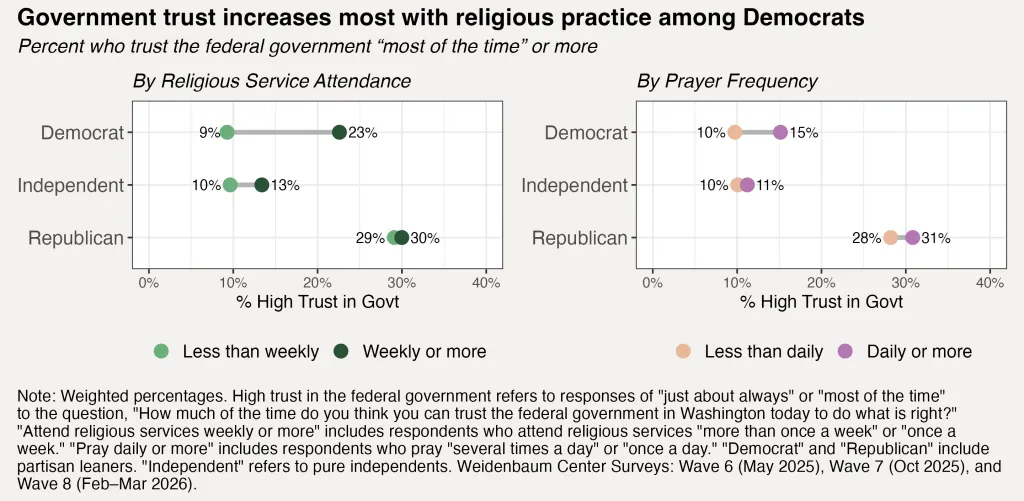
When the relationship between religious practice and trust in the federal government is examined by partisanship, Democrats stand out as the group for whom religious practice makes the greatest difference. Among Democrats, weekly religious service attendance is associated with a 14-percentage-point increase in high trust in the federal government (23% vs. 9%), while daily prayer is associated with a 5-percentage-point increase (15% vs. 10%). This finding is noteworthy given that the surveys were conducted under a Republican administration. In contrast, differences by religious practice are more modest among independents and Republicans. Nevertheless, the overall pattern remains similar across partisan groups, with more frequent religious practice associated with higher trust in the federal government.
In Closing
The findings reveal that a majority of Americans are affiliated with a religion and that more than half of them regularly engage in religious practices. At the same time, even some Americans without a religious affiliation continue to pray or participate in other religious practices, reflecting the growing presence of religious “nones.” Furthermore, religiosity is highest among the youngest and oldest Americans, as well as Republicans, as reflected in religious affiliation and both social and private religious practices. Contrary to some previous research, the WCS data show that both believing and belonging—praying privately and attending religious services—are positively associated with trust in the federal government. These relationships are particularly strong among younger Americans and Democrats.
Although the current data cannot fully explain why both social and private religious practices are associated with greater trust in the federal government, the findings highlight an important pattern: religious practice is positively associated with trust even among Democrats, despite a Republican administration during the survey period. Taken together with previous research showing that politics can shape Americans’ religious identities (Margolis 2018) and that religion and politics mutually shape one another (Campbell et al. 2018), these findings underscore the close and enduring relationship between religion and politics in the United States. As the religious landscape continues to evolve, understanding both believing and belonging will remain essential for understanding Americans’ political attitudes and trust in government.
Author: Hwayong Shin is a postdoctoral fellow at the Weidenbaum Center on the Economy, Government, and Public Policy at Washington University in St. Louis.
Acknowledgement: I am grateful to Taylor Carlson, Kristin Henningfeld, and Elizabeth Larson for helpful comments.
Bibliography
Alper, B. A., Tevington, P., Kallo, A., & Diamant, J. (2025, December 15). Why Do Some Americans Leave Their Religion While Others Stay? Pew Research Center. https://www.pewresearch.org/religion/2025/12/15/why-do-some-americans-leave-their-religion-while-others-stay/
Berggren, N., & Bjørnskov, C. (2009). Does Religiosity Promote or Discourage Social Trust? Evidence from Cross-Country and Cross-State Comparisons (SSRN Scholarly Paper No. 1478445). Social Science Research Network. https://doi.org/10.2139/ssrn.1478445
Brown, D. (2019). Measuring Long-Term Patterns of Political Secularization and Desecularization: Did They Happen or Not? Journal for the Scientific Study of Religion, 58(3), 570–590. https://doi.org/10.1111/jssr.12610
Campbell, D. E., Layman, G. C., Green, J. C., & Sumaktoyo, N. G. (2018). Putting Politics First: The Impact of Politics on American Religious and Secular Orientations. American Journal of Political Science, 62(3), 551–565. https://doi.org/10.1111/ajps.12365
Creel, N. (2021). In God we trust…and Caesar too? Evaluating the link between religiosity and trust in government. International Journal of Sociology and Social Policy, 42(9–10), 795–815. https://doi.org/10.1108/IJSSP-06-2021-0156
Diamant, J. (2025, November 20). Religiousness varies a lot by race among Democrats, relatively little among Republicans. Pew Research Center. https://www.pewresearch.org/short-reads/2025/11/20/religiousness-varies-a-lot-by-race-among-democrats-relatively-little-among-republicans/
Gemar, A. (2024). Institutional Trust, Spirituality, and Religious Practice in the United States. Social Sciences, 13(1), 67. https://doi.org/10.3390/socsci13010067
Godefroidt, A., Langer, A., & Meuleman, B. (2017). Developing political trust in a developing country: The impact of institutional and cultural factors on political trust in Ghana. Democratization, 24(6), 906–928. https://doi.org/10.1080/13510347.2016.1248416
Grzymala-Busse, A. (2020). Beyond War and Contracts: The Medieval and Religious Roots of the European State. Annual Review of Political Science, 23(Volume 23, 2020), 19–36. https://doi.org/10.1146/annurev-polisci-050718-032628
Huber, S., & Huber, O. W. (2012). The Centrality of Religiosity Scale (CRS). Religions, 3(3), 710–724. https://doi.org/10.3390/rel3030710
Jones, J. M. (2025, April 17). Religious Preferences Largely Stable in U.S. Since 2020. Gallup.Com. https://news.gallup.com/poll/659339/religious-preferences-largely-stable-2020.aspx
Joseph, S., & DiDuca, D. (2007). The Dimensions of Religiosity Scale: 20-item self-report measure of religious preoccupation, guidance, conviction, and emotional involvement. Mental Health, Religion & Culture, 10(6), 603–608. https://doi.org/10.1080/13674670601050295
Hill, J. A., Jones, P., & Morales, A. J. (Eds.). (2013). Experiencing Power, Generating Authority: Cosmos, Politics, and the Ideology of Kingship in Ancient Egypt and Mesopotamia. University of Pennsylvania Museum of Archaeology and Anthropology. https://doi.org/10.2307/j.ctt5hjkfv
Kasselstrand, I., Couse, T., & Sanchez, S. (2017). Institutional Confidence in the United States: Attitudes of Secular Americans. Secularism and Nonreligion, 6(0). https://doi.org/10.5334/snr.80
Levin, J., Bradshaw, M., Johnson, B. R., & Stark, R. (2022). Are Religious “Nones” Really Not Religious?: Revisiting Glenn, Three Decades Later. Interdisciplinary Journal of Research on Religion, 18, 1.
Margolis, M. F. (2018). How Politics Affects Religion: Partisanship, Socialization, and Religiosity in America. The Journal of Politics, 80(1), 30–43. https://doi.org/10.1086/694688
Schwadel, P. (2020). The Politics of Religious Nones. Journal for the Scientific Study of Religion, 59(1), 180–189. https://doi.org/10.1111/jssr.12640
Valente, R. R., & Okulicz-Kozaryn, A. (2021). Religiosity and Trust: Evidence from the United States. Review of Religious Research, 63(3), 343–379. https://doi.org/10.1007/s13644-020-00437-8
Zhao, D. (2009). The Mandate of Heaven and Performance Legitimation in Historical and Contemporary China. American Behavioral Scientist, 53(3), 416–433. https://doi.org/10.1177/0002764209338800
Data
The Weidenbaum Center Survey (WCS) was conducted by Washington University in St. Louis’s Weidenbaum Center on the Economy, Government, and Public Policy through the survey firm YouGov on Oct 16–24, 2023 (Wave 1), Feb 15–26, 2024 (Wave 2), May 15–28, 2024 (Wave 3), Oct 15–23, 2024 (Wave 4), Feb 14–24, 2025 (Wave 5), May 15–26, 2025 (Wave 6), October 15–28, 2025 (Wave 7), February 18 – March 2, 2026 (Wave 8). The sample size for each wave was: Wave 1 (n = 3,281), Wave 2 (n = 3,044), Wave 3 (n = 3,182), Wave 4 (n = 3,248), Wave 5 (n = 3,230), Wave 6 (n = 3,535), Wave 7 (n = 3,029), and Wave 8 (n = 3,367). However, the sample size used in each analysis may be smaller because respondents who did not answer the relevant survey questions are excluded. Because there was an oversample of African Americans, the weighted percentages were presented in the results. For partisan identity, “Democrats” include individuals identifying as Strong Democrat, Not very strong Democrat, or Lean Democrat; “Republicans” include those identifying as Strong Republican, Not very strong Republican, or Lean Republican; and “Independents” refer to pure independents who identified as Independent without partisan leaning.